The Problem
APIs often end up with inconsistent authorisation.
Tokens are minted and validated differently across services, permissions are handled ad hoc, and scopes and roles are not managed centrally.
This creates two issues at scale: developers lose time rebuilding security patterns, and security teams struggle to verify that access controls are consistent and least-privileged across endpoints.
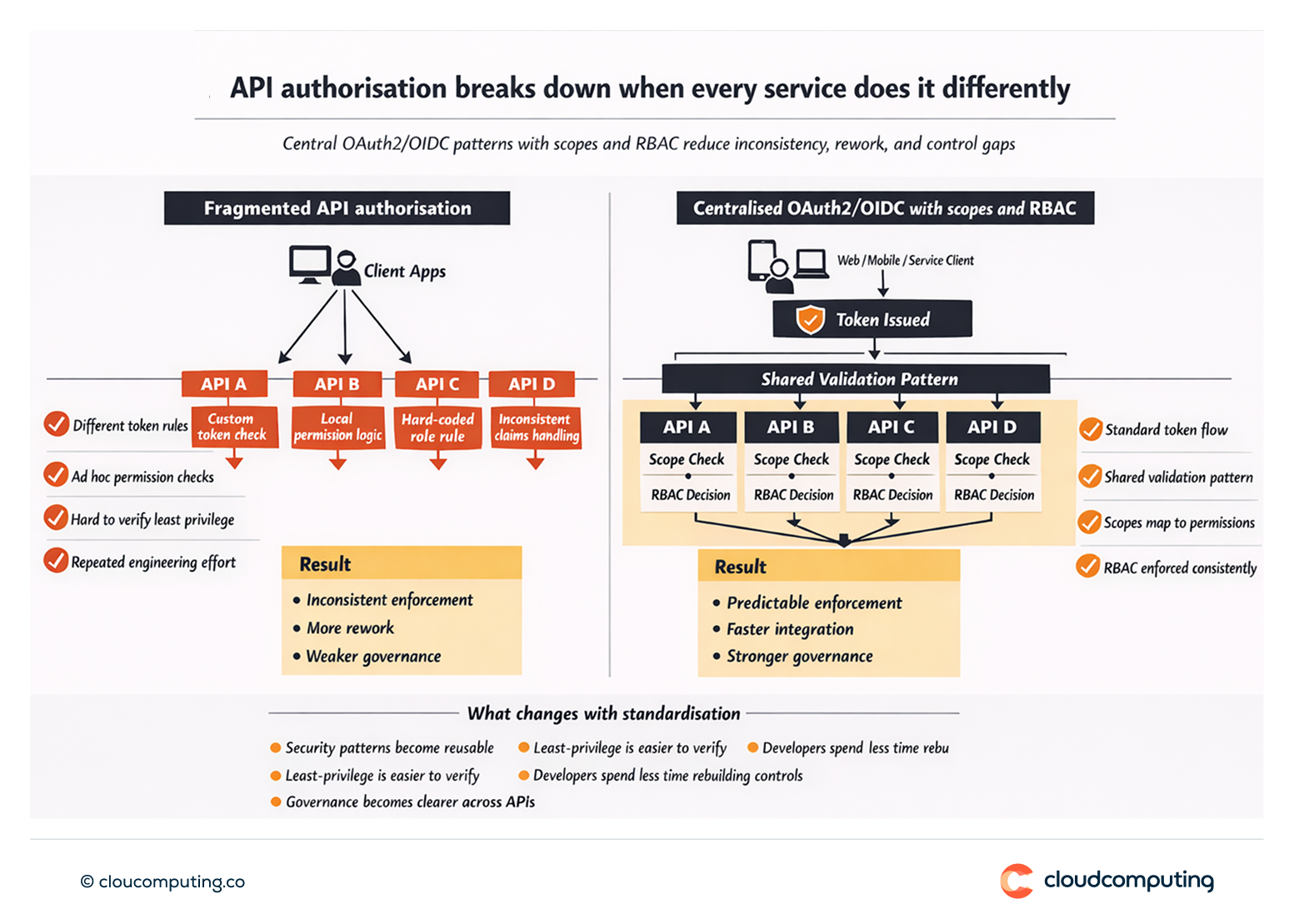
How we solve it: Standardise API protection with OAuth2/OIDC, scopes, and RBAC patterns aligned to business permissions.
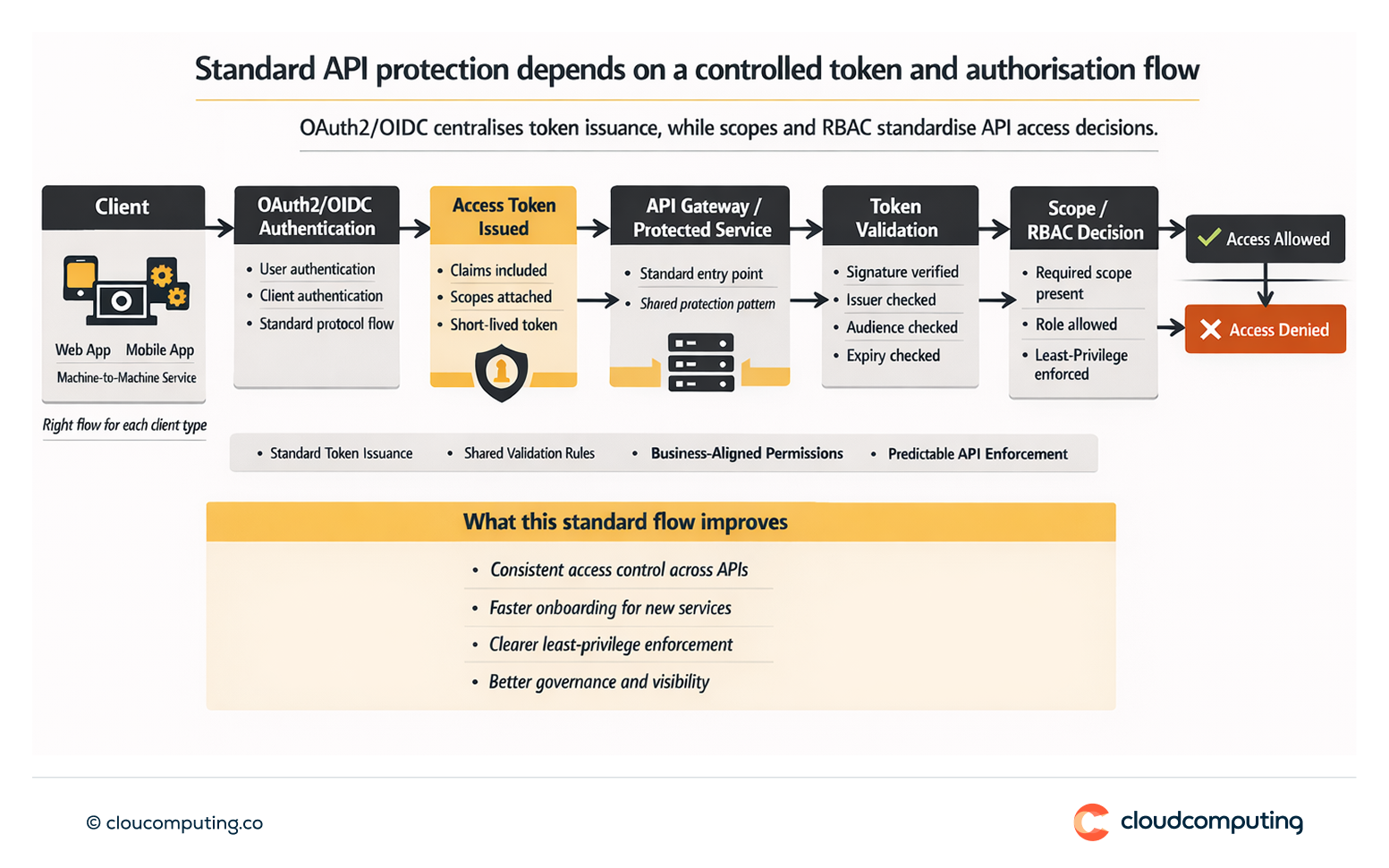
We define a reference architecture for securing APIs, with consistent token flows, validation, and authorisation decisions based on scopes and roles.
- Reference architecture and standards
We define which OAuth2/OIDC flows apply to different clients (web, mobile, machine-to-machine) and how tokens are issued and validated. - Scopes and permissions model
We design a permission model that maps to business capabilities, keeping scopes meaningful and manageable. - RBAC for APIs where appropriate
We implement role-based enforcement for APIs when it supports the product model, reducing ad hoc permission checks. - Developer enablement
We provide templates and guidance so teams integrate faster and avoid inconsistent security patterns.
Expected outcome
- Consistent authorisation across APIs with predictable enforcement
- Safer APIs through centralised token handling and least-privilege permissions
- Faster developer delivery by reusing standard patterns and reducing rework
- Improved governance with clearer ownership and security visibility
Quick Answers
What do OAuth2 and OIDC provide for APIs?
Standard protocols for issuing and validating tokens so API access can be controlled consistently.
What are scopes?
Permission boundaries included in tokens that define what actions a client is allowed to perform.
When does RBAC for APIs make sense?
When your product permissions align to roles that can be consistently enforced across endpoints.